The Sustainability Cliff: 3 Strategic Anchors for Rural Health Funding

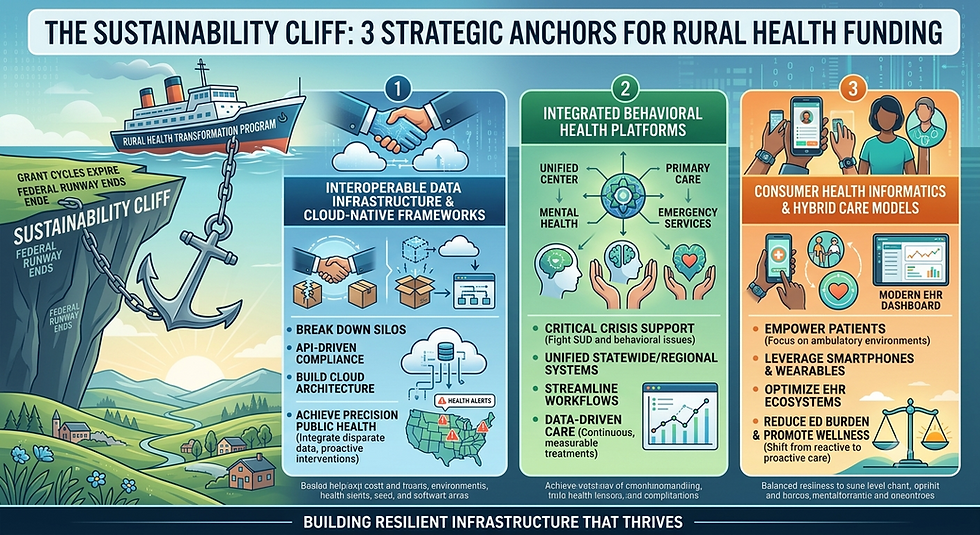
Federal funding injections for rural health transformation programs are a lifeline, but they come with a clock. Far too often, when the grant cycle expires, the innovations built upon them risk fading away. As technology leaders and public health strategists, our mandate cannot simply be to deploy capital—it must be to anchor that capital into infrastructure that thrives long after the federal runway ends.
True transformation happens when we shift our perspective from temporary fixes to sustainable, operationally executable systems. Having sat on both sides of the table…as a state deputy CTO managing public health infrastructure and as an industry executive delivering enterprise cloud modernization…I’ve seen firsthand what sticks and what scales.
To build a rural health ecosystem that is resilient, politically navigable, and technically sound, we must focus our funding on three highly impactful, sustainable areas.
1. Interoperable Data Infrastructure & Cloud-Native Frameworks
Data is the single most vital resource of our time, but in rural healthcare, it is frequently trapped in disconnected, legacy silos. Funding should not be spent on maintaining aging servers; it should be used to build modern, cloud-native frameworks.
Investing in a centralized cloud architecture and robust health informatics interoperability yields long-term financial sustainability by dramatically reducing operational and maintenance costs over time. More importantly, it establishes the foundation for “precision public health.” Enabling rural providers to integrate disparate data streams to direct precise, proactive interventions at the population level before a crisis occurs.
Actionable Focus: Prioritize enterprise data management, API-driven interoperability compliance (HIPAA, HITECH), and the consolidation of multi-agency or regional data pipelines into unified platforms.
2. Integrated Behavioral Health Platforms
Public health is deeply human, and nowhere is the human cost higher right now than in the battle against Substance Use Disorder (SUD) and behavioral health crises. Rural communities are historically underserved in this domain, facing both a severe shortage of specialists and a heavy weight of systemic stigma.
Using transformation dollars to stand up standalone, fragmented clinics is a temporary patch. Sustainability lies in building “integrated behavioral health platforms” that bridge the gap between primary care, emergency services, and mental health providers. Unifying these services into a single statewide or regional digital ecosystem streamlines workflows, eliminates massive administrative backlogs, and ensures continuous, data-driven care delivery.
Actionable Focus: Spend funding on scalable digital platforms like the “Illinois BEACON” model to coordinate care, while exploring clinical adjuncts like consumer health informatics and digital therapeutics that allow individuals to manage their journey sustainably from home.
3. Consumer Health Informatics & Scalable Hybrid Care Models
The traditional, acute-care-centric model does not scale in geographically isolated areas. To achieve true longevity, we must shift clinical governance toward ambulatory environments and consumer health empowerment.
The proliferation of smartphones and wearables means that patients already carry the endpoints of the modern healthcare system in their pockets. Rural health funding should look toward optimizing electronic health record (EHR) ecosystems to ingest consumer-generated health data and supporting hybrid, asynchronous care workflows. When patients are empowered with the tools to understand and navigate their own health analytics, we reduce the burden on rural emergency departments and shift the paradigm from reactive treatment to proactive wellness.
Actionable Focus: Build robust user experiences and multi-language consumer portals that maximize client utilization and value realization. Align these technical investments directly with value-based care initiatives, like Advanced Medical Homes, to unlock recurring, sustainable revenue streams.
The Scholar-Practitioner Perspective: Innovation isn't just about adopting the newest tech trend; it’s about understanding the factors that sustain its usage over time. If we anchor our federal funding in interoperable clouds, unified behavioral health systems, and consumer-driven tech, we won't just hit our grant milestones…we will fundamentally transform how healthcare is delivered to those in our rural communities.


Comments