Moving Fast Without Breaking Things: A Pragmatic Blueprint for AI in Healthcare (Part 1)

There is a profound difference between reading about artificial intelligence and actually being responsible for deploying it within a complex health system. When you are the one sitting in the leadership seat, the questions carry an immense weight. Which tool do you choose when the market shifts every single week? How do you absolutely guarantee that patient data isn't exposed to unnecessary risk? And even if you manage to solve the technical riddles, how do you get exhausted clinicians to actually adopt the technology?

I have looked at these challenges from almost every angle imaginable. Long before my time serving as a state Deputy CTO or driving transformation in Big Tech, I was deep in the trenches of healthcare delivery. I held Director-level roles at two different academic medical centers, overseeing the daily operations of massive electronic health record and revenue cycle management ecosystems. When you are directly responsible for the systems that support thousands of users, impact patient care, and manage the financial lifeblood of a hospital, you learn very quickly that "moving fast and breaking things" is an incredibly dangerous philosophy. Healthcare requires a much more pragmatic approach to innovation.
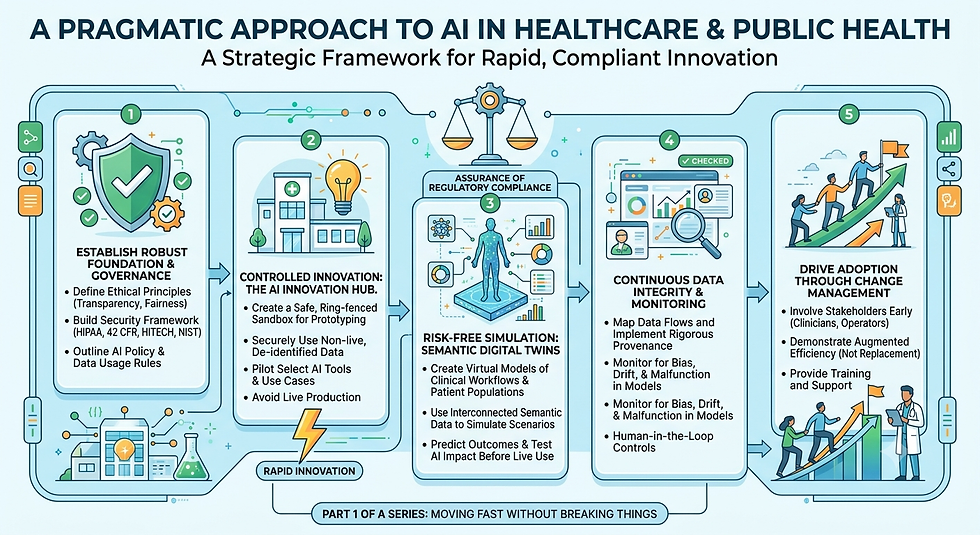
You don't need to bet your entire infrastructure on an untested algorithm. Instead, the most successful organizations are carving out dedicated, ring-fenced environments to evaluate these emerging technologies. Think of it as an internal proving ground for your digital strategy. By establishing a dedicated innovation hub, your technical and clinical teams can rigorously prototype new solutions away from live production data. It allows you to rapidly separate the vendor hype from actual, operational utility while remaining fully compliant with regulatory standards.
But how do you test clinical impact without touching real patients? This is where I am seeing tremendous value in advanced data modeling. Forward-thinking organizations are beginning to leverage highly sophisticated digital replicas of their clinical environments. By creating virtual models of clinical workflows or patient populations powered by interconnected, semantic data, you can simulate exactly how an AI tool will behave before it is ever deployed to the floor. It is a brilliant way to predict outcomes, identify workflow bottlenecks, and refine the technology in a completely risk-free setting.
Yet, even the most secure and thoroughly tested technology will fall flat if you ignore the human element. Change management isn't just a phase of the project; it is the entire ballgame.
In my experience rolling out major enterprise systems, the fundamental truth always remains the same. Technology is only as effective as the people willing to use it. Driving adoption means bringing your clinical and operational stakeholders into the design process on day one. They need to see firsthand, within that innovation hub, that these tools are designed to augment their expertise and lift their administrative burdens, not replace their clinical judgment.
In part two of this series, we will explore the governance structures necessary to keep these tools in check and how to measure true clinical efficacy once you move out of the sandbox.


Comments