Part 7: Does the NIST AI RMF Adequately Address All of This?

Responsible AI and Social/Cultural Acceptance
Short answer: it's a strong, well-designed foundation for the Responsible AI side, and it was never intended to single-handedly answer the acceptance question; that was outside its scope by design, not by oversight.
What it does well:
The four functions — Govern, Map, Measure, Manage — give a flexible, outcome-oriented structure that scales from a startup to a multinational, and NIST explicitly frames trustworthiness characteristics (validity, safety, security, accountability, explainability, privacy, fairness) as socio-technical and context-dependent, not purely mathematical.
It's deliberately cross-sectoral rather than one-size-fits-all, and extends itself through Profiles rather than version bumps. The Generative AI Profile (NIST AI 600-1, 2024), with a Trustworthy AI in Critical Infrastructure Profile concept note released in April 2026. That's the layered, sector-adapted model working as intended, and it's a stronger architecture than people sometimes give it credit for.
It treats AI risk management as continuous and lifecycle-oriented, not a one-time certification…which matches how these systems actually behave in production.
Where it structurally doesn't reach:
The AI RMF provides architecture, not a finished governance program. Organizations still have to determine what responsible AI means in their specific context. NIST cannot do that determination for you.
It's not a substitute for sector regulation, organizational ethics, professional standards, cybersecurity and privacy governance, procurement controls, or democratic accountability. It was never meant to be the whole ecosystem, just one important piece of it.
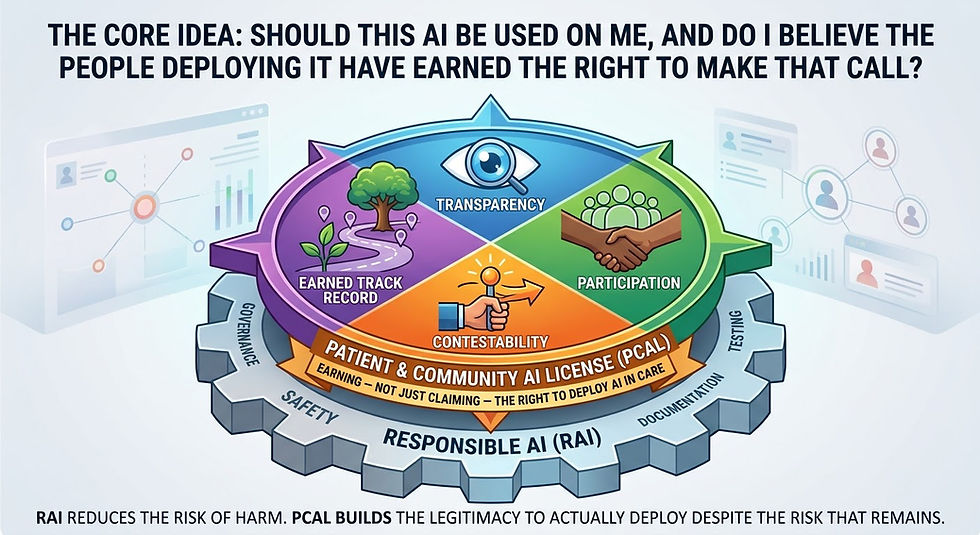
Most importantly, it cannot independently answer "what should society accept?" That's a values question, not a risk-management question, and no technical framework can resolve it on an organization's behalf.
It's voluntary and largely organization-facing, with no enforcement teeth of its own; adoption depends on procurement pressure, sector regulators, and reputational incentive rather than legal mandate.
The OECD's AI Principles are a useful complement here, since they explicitly name human rights, democratic values, human agency and oversight, and stakeholder engagement as components of trustworthy AI…closer to the acceptance side of the ledger than NIST's risk-management framing.
The honest conclusion: NIST AI RMF is an excellent foundation for managing AI risk, and increasingly sector-aware through its Profile mechanism. It was never designed to be…and shouldn't be mistaken for…the mechanism that earns public trust. Organizations that treat it as their only framework will be well-governed and still occasionally blindsided by acceptance failures. We'll need an ecosystem of technical standards, sector regulation, organizational governance, professional ethics, public engagement, AI literacy, independent evaluation, and international cooperation. Interoperable layers, not a single document.



Comments